The Name of the Game is the . . . Spec?
Retractable Technologies, Inc. v. Becton, Dickinson And Company, 2010-1402 (July 8, 2011) [LOURIE, Rader, Plager] the Federal Circuit affirmed in part and reversed in part judgment that Becton Dickinson infringed U.S. Patent Nos. 5,632,733, 6,090,077, and 7,351,224 on syringes with retractable needles.
DISCUSSION: The primary issue on appeal was whether the district court erred in construing “a hollow syringe body” in several of the claims in dispute as not being limited to a one-piece hollow syringe body.
While there was a dependent claim that limited the body to a “one-piece body” which tended to imply the independent claim was not so limited, the Federal Circuit found that this implication was “not a strong one”, noting that independent claim that “none of the claims expressly recite a body that contains multiple pieces”.
The Federal Circuit said that “[i]t is axiomatic that the claim construction process entails more than viewing the claim language in isolation” and that [c]laim language must always be read in view of the writ-ten description”. The Federal Circuit found that the specification indicated that “body” referred to a one-piece body. The Federal Circuit pointed to the Background of the Art said:
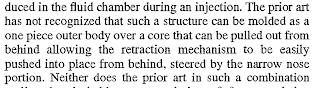
U.S. Patent No. 5,632,733, col. 2, ll. 26-31. The Federal Circuit also pointed to the Summary of the Invention:
U.S. Patent No. 5,632,733, col. 2, ll. 45-47. The Federal Circuit noted that the Detailed Description repeatedly mentions the one-piece construction:

U.S. Patent No. 5,632,733, col. 5, ll. 54-56.

U.S. Patent No. 5,632,733, col. 10, ll. 9-10. In contrast, the Federal Circuit noted that the “specifications do not disclose a body that consists of multiple pieces or indicate that the body is anything other than a one-piece body”.
Noting that there is a fine line between construing the claims in light of the specification and improperly importing a limitation from the specification into the claims, the Federal Circuit identified it “strive[s] to capture the scope of the actual invention, rather than strictly limit the scope of claims to disclosed embodiments or allow the claim language to become divorced from what the specification conveys is the invention.” The Federal Circuit said that “while the claims leave open the possibility that the recited ‘body’ may encompass a syringe body composed of more than one piece, the specifications tell us otherwise.” The Federal Circuit concluded that “a construction of “body” that limits the term to a one-piece body is required to tether the claims to what the specifications indicate the inventor actually invented.”
SIGNIFICANCE:
1. While Judge Rich famously proclaimed “the name of the game is the claim” (Giles S. Rich, The Extent of the Protection and Interpretation of Claims-American Perspectives, 21 Int'l Rev. Indus. Prop. & Copyright L., 497, 499 (1990) ("To coin a phrase, the name of the game is the claim."), in a post-Philips world the specification is can undo the work of a careful claim drafter.
2. When drafting a specification, describe alternatives, and when an adjective is used (e.g. one-piece) specifically contemplate alternatives.
3. When employing claim differentiation, don’t rely on a dependent claim specifically claiming the preferred embodiment to broaden the base independent claim, specifically claim alternatives to the preferred embodiment.
Labels: Canons, Drafting Tip, Federal Circuit
posted by Bryan @ 5:07 PM


